SMAT Audit360: audit automation for fuel price differential claims.
In short SMAT Audit360 is offline Windows software, built by DeviSofts, that lets Chartered Accountant firms audit the Price Differential Claims (PDC) that oil marketing companies file with the energy regulator. It reads the client's documents, tests every claimed invoice against 22 audit rules, calculates the verified PDC and produces the certificate and annexures, without sending a single file to the cloud.
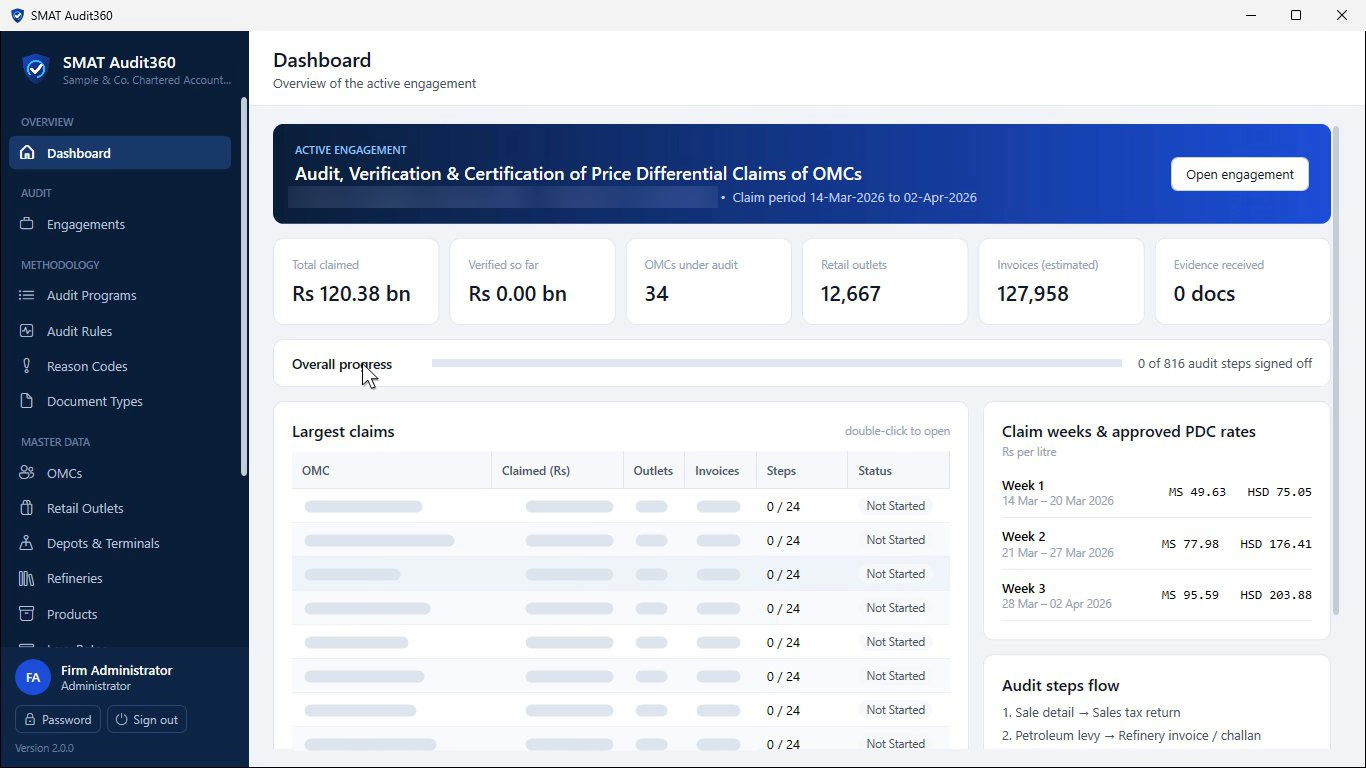
Engagement dashboard.
The engagement dashboard: total claimed, companies under audit, outlets, invoices, evidence received, overall sign-off progress and the approved PDC rate for each claim week. Client names and amounts in the "Largest claims" table are redacted.
- Product
- SMAT Audit360, version 2.0.0 (November 2026)
- Built for
- Chartered Accountant firms auditing fuel price differential claims
- Audit scope it handles
- 34 oil marketing companies · Rs 120.38 billion claimed · about 128,000 invoices · 12,667 retail outlets
- Platform
- Windows 10/11 or Windows Server, 64-bit desktop application
- Database
- Microsoft SQL Server 2016 or later, on one PC or shared over the office network
- Connectivity
- Fully offline: no internet connection or cloud service is used
- Automation
- 22 audit tests on every invoice · 24 document types recognised · offline OCR for scans
- Deliverables
- Certificate per claim week (Word) · annexure workbook (Excel) · consolidated engagement report
- Quality evidence
- 64 automated tests · finds 125 of 125 deliberately injected exceptions end to end
128,000 invoices.
Sixty days.
The 2026 PDC audit terms of reference set a scale that manual testing cannot cover.
Volume
Every claimed invoice must be traced through a chain of evidence. By hand, that means sampling, and sampling leaves most of the claim untested.
Scattered evidence
Sales tax returns, ERP exports, customs declarations, refinery invoices (often scanned), delivery slips, bank statements and stock reports, in PDF, Excel and paper.
Confidentiality
The terms of reference require client documents to stay confidential, so the work cannot be pushed to a cloud service or an online AI tool.
The full audit cycle,
in one offline app.
From installation to a signed-off certificate, every stage of the engagement runs inside SMAT Audit360 on the firm's own machines.
Set up
A setup wizard finds SQL Server on the PC or office network, creates the database and connects more PCs to the same installation. Users get one of five roles, with account lockout and forced password change.
Open the engagement
Claim weeks with their approved PDC rates, and one audit file per oil marketing company. The 2026 PDC engagement (34 companies, 3 claim weeks) loads in one click.
Receive evidence
Drop in files or whole folders. Each file is hashed with SHA-256, de-duplicated, classified into one of 24 document types and stored read-only.
Process documents
The claim workbook (Annex A to I), ERP sales export, sales tax return, customs GDs, sales and pipeline invoices, levy statements, depot stock reports and the Form-K outlet list become structured data. Scanned refinery invoices are read with offline Windows OCR.
Run the audit tests
22 tests run on every claimed invoice. Each invoice is classified with a reason code, litres sold beyond available stock are deducted, and the verified PDC is calculated per claim week and product.
Review
Auditors confirm an exception or clear it with a note, and can override an invoice's outcome with a written reason. Decisions are kept when the tests run again.
Sign off
Each audit step is signed off by a preparer and then by a different reviewer, so segregation of duties is enforced by the software.
Report
A certificate for each claim week in the TOR wording, an annexure workbook and a consolidated engagement report. Weeks with open items are saved as clearly marked drafts.
Screens from
version 2.0.0.
Captured from the release build running the product's demo engagement. Click any screen to zoom.
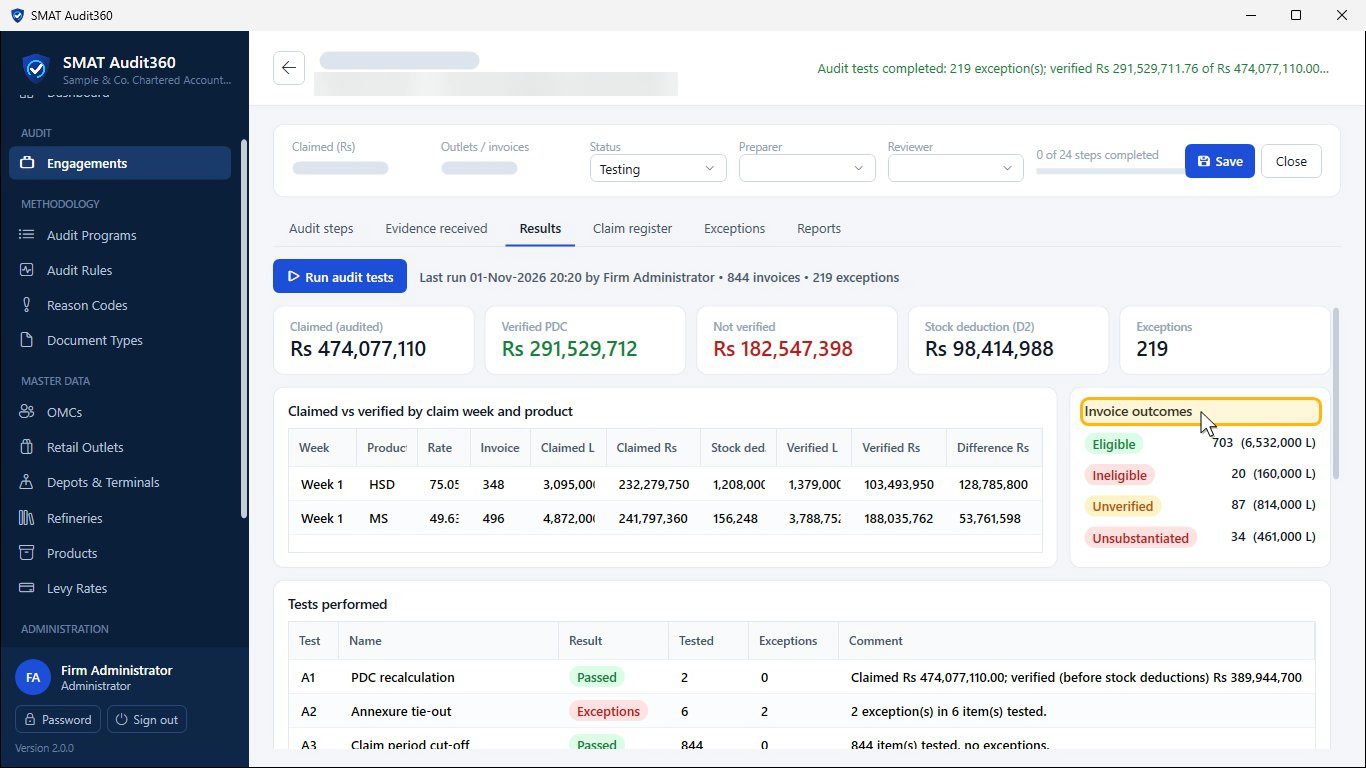
Audit test results.
Results after one click on "Run audit tests": verified PDC, amount not verified, stock deduction (test D2), invoice outcomes and every test performed with its exception count. The company name and claim header are redacted.
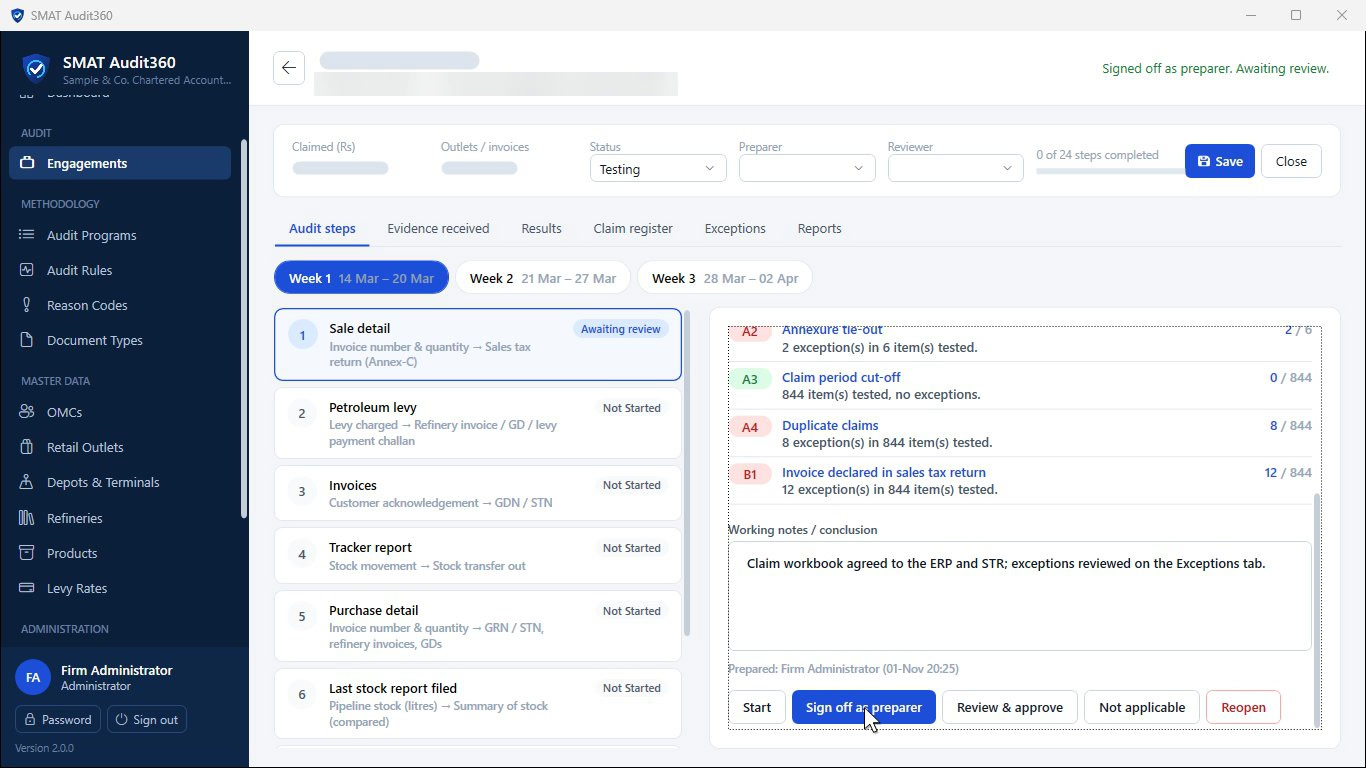
Audit steps and sign-off.
The audit programme for each claim week. Every step shows the results of its own tests, takes working notes, and is signed off by a preparer and then a different reviewer (segregation of duties).

Configurable audit rules.
The 22 audit rules live in the database, not in code. A firm can switch a test on or off and change its severity, outcome and parameters without a software update.

Offline setup wizard.
A six-step setup wizard finds SQL Server on the PC or office network, creates the database, and connects further PCs to an existing installation. Everything stays on the firm's own server.
Company names, claimed amounts and outlet counts from client documents are redacted in these screenshots. Nothing shown identifies a client or its audit findings.
22 audit tests,
on every invoice.
The tests follow the TOR's audit programme. Parameters, tolerances and outcomes are editable by the firm.
| Group | Tests | What they check |
|---|---|---|
| A · Claim integrity | A1–A4 | The PDC recalculated at the approved weekly rate, annexures tied out, invoices inside the claim week, and no duplicate invoices. |
| B · Sales authenticity | B1–B8 | Invoice declared in the sales tax return, matching the ERP record, signed customer acknowledgement, delivery documents, a feasible vehicle trip, retailer payment in the bank statement, withholding tax deposited, and a licensed retail outlet on the Form-K list. |
| C · Purchases & levy | C1–C4 | Local purchases and imports agree to refinery invoices, customs declarations and the sales tax return; petroleum levy paid in full; scanned refinery invoices agree to the levy statement. |
| D · Stock | D1–D3 | Daily stock roll-forward per depot, sales within available stock (excess litres are deducted), and the claim's stock figures agree to depot reports. |
| E · Outlet analytics | E1–E3 | Abnormal sales spikes, outlets that appear dormant from their electricity use, and the same outlet or vehicle in another company's claim on the same day. |
Every invoice ends with one outcome
All required tests passed.
Fails a TOR eligibility condition, e.g. not in the sales tax return.
Required evidence was not provided.
Evidence contradicts the claim.
An analytics flag for auditor judgement; it does not change the outcome on its own.
Verified PDC = Σ over claim weeks and products of (eligible litres − stock deduction) × approved weekly rate
Built for evidence
that must not leak.
Audit evidence is confidential and must stand up to review. The design starts from both requirements.
Fully offline
No cloud features at all. OCR runs on the PC with the Windows OCR engine, and data stays on the firm's own SQL Server.
Tamper-evident evidence
Every received file gets a SHA-256 hash and a read-only copy in the evidence store. Duplicates are detected automatically.
Access control
Five roles, PBKDF2-SHA256 password hashing with 120,000 iterations, account lockout and forced password change. Database credentials are encrypted with Windows DPAPI.
Accountability
A field-level audit trail, enforced preparer/reviewer separation, written reasons for every override, and one-click SQL Server backups.
Configurable, tested
and documented.
How we made sure the numbers on a certificate can be trusted.
Technology
A modular .NET solution in seven projects: core model, data, document ingestion, rules engine, reporting, OCR and the desktop app.
Testing
- 64 automated tests cover security, installation, document classification, parsers and the rules engine.
- A golden end-to-end test imports a full claim week (112 documents, including 18 scanned refinery invoices), runs every test and generates every report.
- It must find all 125 exceptions deliberately injected into the sample, and it does.
No hard-coded methodology
Audit programmes, rule parameters, reason codes, document-type keywords, levy rates and certificate wording live in the database. A firm can adapt the software to its own methodology, or to a different audit, without new code.
Handover
A self-contained installer that needs no .NET on the target PC, plus an installation guide, user guide, audit methodology, architecture guide and a 20-minute video guide in Urdu, in 16 chapters, recorded from the release build.
From sampling
to full coverage.
- Every claimed invoice is tested, not a sample, and the verified PDC is calculated for each claim week and product.
- Every exception is explainable: it carries a reason code, the test that raised it and the evidence it came from.
- Review work is never lost: confirmed exceptions, cleared items and overrides survive a re-run of the tests or a corrected client file.
- Certificates are generated, not typed: one per claim week, saved as a draft until its open items are closed and its steps are signed off.
SMAT Audit360,
answered.
What is SMAT Audit360?
Who is SMAT Audit360 built for?
Does SMAT Audit360 need an internet connection or a cloud service?
Which audit tests does it run?
Can an audit firm change the rules without programming?
What reports does SMAT Audit360 produce?
What technology is SMAT Audit360 built with?
How was the software tested?
Have a regulated, document-heavy process
worth automating?
We build secure business software (ERP, POS, audit and compliance tools) that runs where your data has to stay. Tell us about yours.